
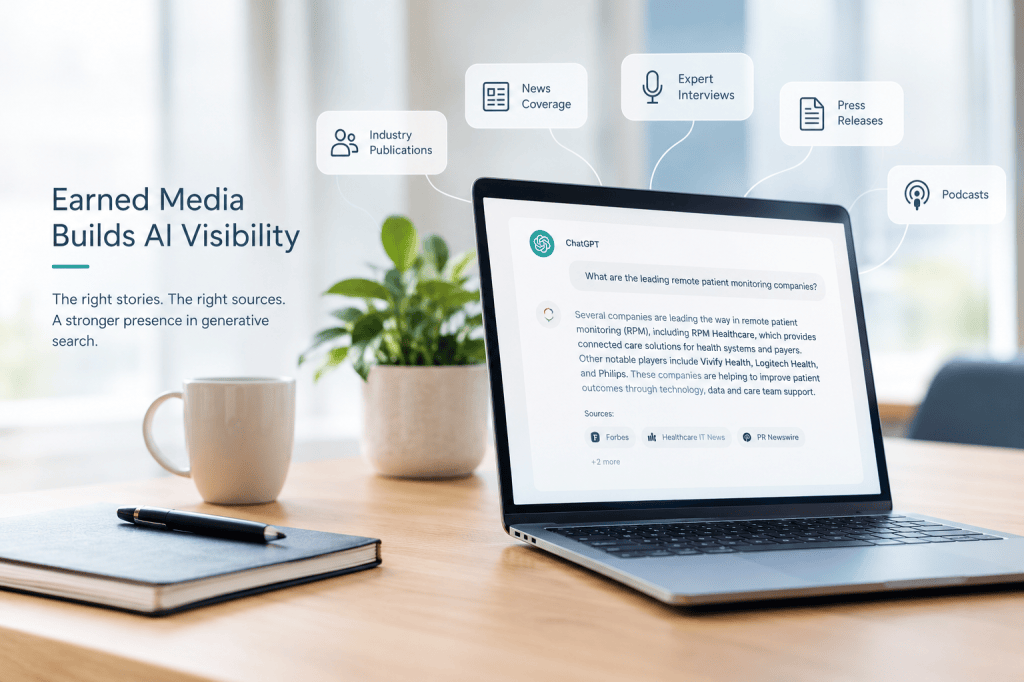
For years, public relations has struggled with visibility.
Not because PR stopped working, but because it became harder to measure. SEO had rankings. Paid media had clicks and conversions. Social media had followers and engagement. PR had something more difficult to quantify: credibility. I remember telling clients that if you could accurately track public relations value, you’d have a billion-dollar tool on your hands.
Generative AI may be changing that.
As more people turn to ChatGPT, Gemini, Claude and other AI-powered search tools for answers, Generative Engine Optimization (GEO) is emerging as a new priority for brands. And unlike traditional search, where brands can optimize their own websites to compete for rankings, GEO depends heavily on something companies cannot simply create for themselves: third-party credibility.
That puts public relations back in the spotlight.
What is GEO?
Generative Engine Optimization is the practice of improving a brand’s visibility and representation in AI-generated answers.
The goal is no longer simply to rank on page one of Google. It is to become one of the sources an AI system considers credible enough to reference when answering a question.
That distinction matters.
Someone searching Google for “remote patient monitoring companies” may see a page of websites, advertisements and articles. Someone asking an AI platform the same question may receive a synthesized answer naming several companies, explaining their differences and citing the sources used to build that answer.
The question for brands is no longer just, “Can people find us?”
It is increasingly, “Does AI know who we are, what we do and why we are credible?”
The data is good news for PR
This is where GEO gets particularly interesting for communications teams.
Muck Rack’s May 2026 What Is AI Reading? research analyzed more than 25 million links cited in responses from ChatGPT, Claude and Gemini across 17 industries. The study found that 84% of AI citations came from earned media, while journalism alone accounted for 27%. Paid and advertorial content represented just 0.3%.
That finding has significant implications for PR.
AI systems don’t just look at what a company says about itself on its website, blogs and press releases. They are looking for signals from the broader information ecosystem: what journalists report, what industry publications say, what experts contribute to conversations and what credible third parties have published.
In other words, reputation is becoming searchable in a fundamentally different way.
And PR has spent decades building reputation through exactly those channels.
PR is becoming part of the AI infrastructure
This does not mean every press release will suddenly become an AI citation. Muck Rack’s research suggests press releases themselves are cited less frequently than other forms of earned coverage. Their value can be more indirect: a strong announcement can give journalists the facts, data and context they need to develop their own stories, which then become part of the broader information ecosystem AI draws from.
The GEO opportunity is not about flooding the internet with more content. It is about creating credible, ongoing evidence that reinforces what a brand is known for.
That might mean:
- A healthcare executive quoted in a respected trade publication
- Original research referenced by multiple outlets
- A podcast interview that establishes an executive as an expert
- A timely contributed article addressing an emerging industry issue
- A press release that leads to meaningful third-party coverage
- Consistent descriptions of the company, its executives and its expertise across authoritative sources
Each individual piece contributes to a larger picture.
And that picture is increasingly something AI systems can see.
That does not mean PR should start writing for robots. Quite the opposite.
The fundamentals remain remarkably human: have something interesting to say, have an expert who can say it well, bring original data or perspective to the conversation, and earn the attention of credible publications.
The difference is that those efforts now have another downstream benefit.
A media placement can reach a journalist. It can reach that journalist’s audience. And increasingly, it can become a source that informs an AI-generated answer months later.
That gives earned media a longer shelf life, and gives PR leaders a new way to think about the value of a placement.
The future of PR is being found in the answers
SEO taught brands to compete for rankings.
Social media taught them to compete for attention.
GEO is creating a new competition: to become a trusted source of information.
That is why the rise of generative search may ultimately be very good news for public relations.
The brands most likely to stand out will not necessarily be the ones producing the most content. They will be the ones with the strongest body of credible information surrounding them.
For healthcare companies in particular, where trust, expertise and accuracy are essential, that creates an enormous opportunity.
GEO is making the value of earned credibility easier to see.

